The Context Layer That AI Agents Need Most Is the One Enterprises Have Not Built Yet

Every enterprise that adopts and builds on AI today faces the same invisible problem. The models are good. The agents are capable. Somewhere upstream, a pipeline is quietly delivering data that should never have reached production. 

The failure does not announce itself. There is no crash, no error code, no alert from the system that just acted on three days of drifted values. The agent reasons fluently on what it receives and produces outputs that look coherent, feeding into business decisions. Someone eventually notices a demand forecast that is consistently off. A customer cohort that stopped reflecting reality. They trace it back. The data was broken the whole time. The agent never knew.

This is what “garbage in, garbage out” looks like in an agentic system. Not obviously wrong. Precisely, silently wrong. And the gap between when it started and when anyone found out is where the real damage lives.

Agents Consume Anomalous Data With the Same Confidence As Clean Data

Every data team has someone who just knows. This individual knows the pipeline that feeds the board dashboard ran late last Tuesday, and the numbers need a second look before they go anywhere important. He or she knows the revenue table that finance actually trusts is not the one marked as the official source of record. This individual knows when a volume looks thin, when a distribution has shifted, and when something passed validation checks but should not have. That instinct took years to build. It lives entirely in her head.

An AI agent has access to the same tables, schemas, and catalog entries. What it does not have is any of that instinct. It cannot smell when something is off. It will consume anomalous data with exactly the same confidence it consumes clean data, because from its position, there is no visible difference.

This is where the failure modes that data teams actually hit in production come from.

A pipeline delivers 15% of its expected row volume. The agent builds a downstream forecast based on a statistical fragment and does not flag the input as unusual because nothing in its context indicates the volume is wrong. A column is silently renamed in an upstream schema change. The agent maps null values across thousands of records, treats them as meaningful, and produces outputs that are structurally coherent but semantically broken. A training distribution shifts as upstream sources evolve, and the model continues extrapolating from a pattern that no longer exists in the data it is consuming.

In each case, the agent proceeds. A data engineer reviewing the same input would have stopped. The agent does not stop because it has no quality signal indicating that it should. And by the time a business stakeholder surfaces the anomaly, the agent has already acted on that data hundreds of times across every downstream system it touches.

Anomaly Detection At the Access Layer Is Structurally Too Late for Agentic Pipelines

When data teams discover this problem, the standard response is more monitoring downstream. Quality dashboards. Anomaly reports. Stewards are assigned to review signals after the pipeline completes. This approach was designed for a BI world and it fails entirely in an agentic one.

Autonomous systems do not run one query and wait. They make thousands of micro-decisions per second, each one reading from the same tables that a downstream dashboard has not yet flagged. The interval between ingestion and detection is not a gap you can engineer away at the monitoring layer. It is structural. And in an agentic pipeline, everything that happens inside that interval is already done by the time any downstream signal fires.

Late-stage detection was a tolerable delay when a broken dashboard was a contained incident that a data steward could fix before the next reporting cycle. In an agentic architecture, a broken signal at ingestion is a cascading event. The damage does not sit in one place waiting to be found. It propagates silently through every downstream system the agent touched before anyone knew to look.

The fix cannot live downstream. It has to move to where the data is born.

A Quality Signal That Does Not Reach the Context Layer Does Not Exist for the Agent

For agents to act correctly on data, trust has to be established when the data lands, not after it has already been committed to production tables. That means validating data as it arrives in open table formats like Apache Iceberg and Delta Lake at the ingestion layer. It means running ML-driven anomaly detection, schema drift checks, and volume validation before a dataset is published downstream. Each of the failure modes described above, the volume drop, the silent schema change, the distribution shift, is detectable at ingestion. 

But a quality signal generated at ingestion and sitting inside an observability tool solves only half the problem. An agent querying a dataset does not consult your observability platform before it acts. It consults whatever context layer it has access to at inference time. If the trust signal does not travel with the data into that context layer, the agent operates without it.

This is the seam most enterprises are missing. Governance platforms, semantic layers, and quality tools are all present in the stack. But an agent does not experience those systems as a unified context. It experiences three separate APIs, three separate schemas, maintained by three separate teams, none of which were designed to speak to each other at the moment of decision. The fragmentation that a skilled data engineer can reason through in ten minutes is invisible, unresolvable noise to an agent operating in milliseconds.
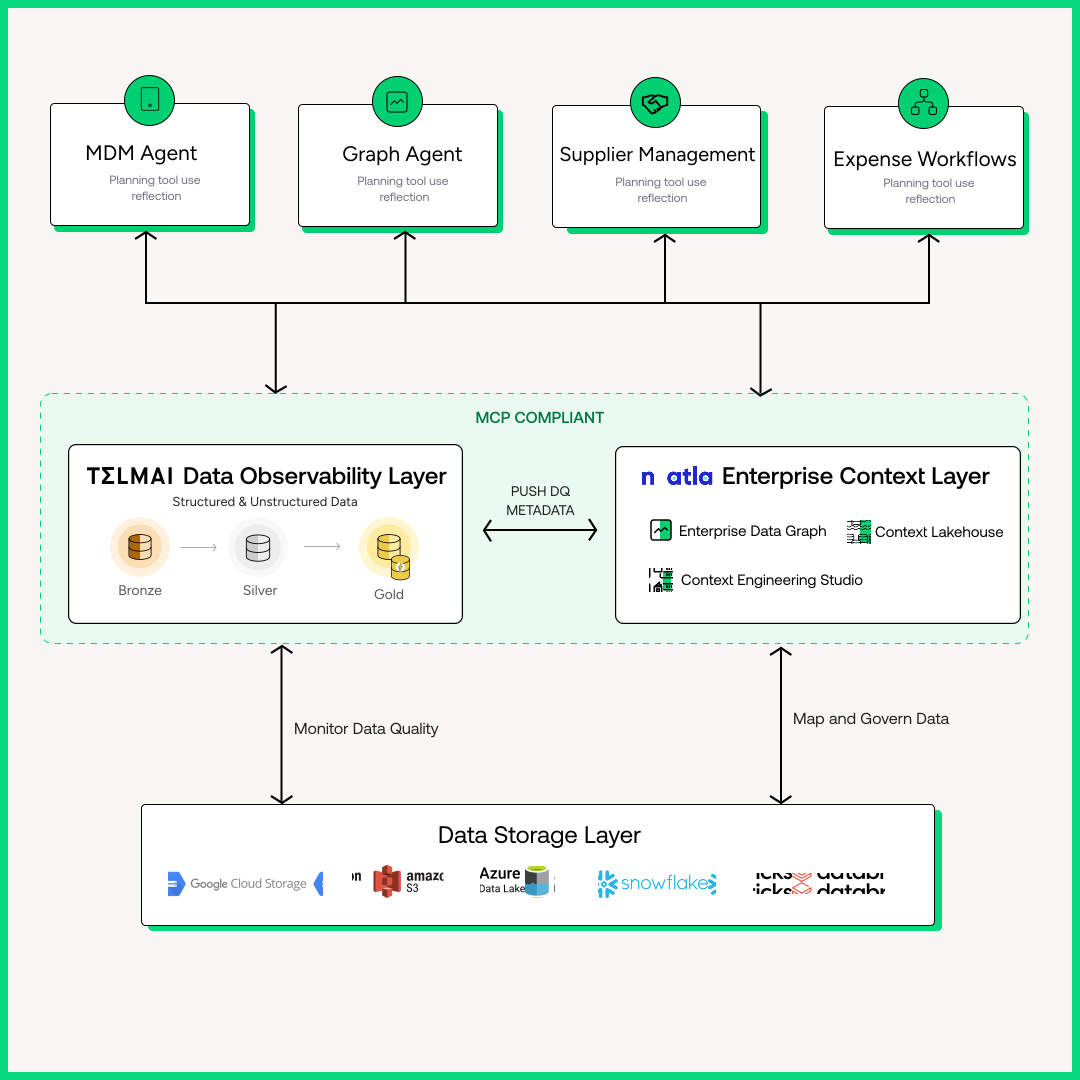
Telmai + Atlan metadata lakehouse

The integration between Telmai and Atlan’s Enterprise Context Layer closes exactly that seam. Telmai’s quality metadata, freshness indicators, anomaly flags, schema change history, and volume drift signals flow into Atlan and become part of the enterprise context layer, joining semantic context, knowledge relationships, and policy rules to form the complete picture an agent needs at inference time. When an agent accesses a dataset, it sees whether the data passed validation on the last ingestion run, whether anything drifted overnight, and whether the table carries an active quality flag from the pipeline layer. That reconciliation happens once, upstream, through Atlan’s App Framework, so agents receive a single coherent trust signal rather than three partial ones they have no way to synthesize at inference time.

Trust built at the source. Context that carries it forward. That is the sequence that makes agents reliable in production, not just capable in pilots.

Without Quality Context Agents Treat Every Input as Valid by Default

Without this foundation, agents operate on assumptions that never get surfaced. They assume the table is current and the schema matches what they were trained on. They assume the volume is within normal bounds. A data engineer reviewing the same input checks, questions, and knows which pipelines to distrust on which days of the week.

An agent does not distrust anything. It consumes. And each silent assumption is a small, compounding bet that the data is fine. Most of the time it is. When it is not, nothing slows down. The agent just proceeds.

The companies that are moving from AI pilots to AI production have one thing in common. They stopped treating data quality context as instrumentation and started treating it as infrastructure. Not a dashboard to review after the fact. A signal generated at ingestion, carried through the context layer, and available at the moment an agent needs to make a trust decision.

Atlan Activate on April 29 is where that infrastructure conversation is landing, with Atlan making its most significant product announcements around the Enterprise Context Layer, the foundation that gives AI agents the business meaning, relationships, and rules they need to act on enterprise data correctly. Data quality signals are not one input among many into that layer. They are the input that determines whether every other piece of context can be trusted.

Build trust at the source. Carry it forward with context. Everything else depends on those two steps being done in sequence.

To learn more about how Telmai can help you build trusted, AI-ready data pipelines, book a tailored demo with our team of experts today.

Want to stay ahead on best practices and product insights? Click here to subscribe to our newsletter for expert guidance on building reliable, AI-ready data pipelines.
The Data Quality Blueprint in 2026

For years, data quality has been framed as a reporting problem. Analysts review dashboards, business leaders ask questions, and when something looks off, someone investigates. That model worked when data was primarily consumed by humans.

In a recent webinar, Max Lukichev, CTO and Co-founder at Telmai, and Saravana Omprakash, Co-founder at DataColor AI, made a compelling case that this approach is fundamentally broken in the age of agentic AI.

Enterprise data usage has fundamentally changed. Data is no longer accessed by a small set of known consumers on a periodic basis. It is now used broadly, continuously, and often autonomously by AI agents embedded across workflows.

This shift alone breaks most traditional data quality models. But it also forces a deeper question. If machines are acting on data directly, what does it actually mean to trust that data?

That question sits at the center of the 2026 data quality blueprint.

Why the Old DQ Playbook Fails in the Agentic Era

The classic data quality model evolved around business intelligence. Data was curated, aggregated, and periodically reviewed through reports. In practice, this meant rule-heavy frameworks that validated tables at the end of the pipeline, typically in the data warehouse. If an issue surfaced, teams had time to investigate, add a rule, and move on.

But agentic AI has shattered that predictability. As Max put it bluntly during the discussion, “Now everyone is building agents, right? You have nearly everyone on a team building something to address a narrow task. The impact of these agents is much broader, given their access to data. You kind of don’t even know how this data is being used, by whom, what decisions are being made.”

Saravana captured another dimension of this failure: many organizations respond by scaling rules instead of strategy. “One of the things I’ve observed is that organizations take a very table-schema focused approach,” he explained. “They say, ‘I’ve got 20 schemas, I’ve got 500 tables—let me run 2000 rules on top of them,’ instead of asking what’s actually important for the business.”

This shotgun approach to blanket rules across every table in the warehouse misses the forest for the trees. It’s reactive, expensive, and ultimately ineffective because it treats all data as equally important. But as both speakers emphasized throughout the conversation, you cannot boil the ocean.

In an agentic environment, data quality can no longer be reactive. Once an agent has acted on bad data, the damage is already done.

From Table-Centric Rules to Business-Centric Trust

So what does a business-first approach look like?

Saravana articulated a principle that became a throughline in their discussion. “What I have seen successfully implemented as DQ initiatives that can translate into business outcomes has been the fact that taking a KPI-first, or a metric-first kind of data quality approach,” he explained. “Because it is not about whether I’ve got the right rules. It is about whether those rules align with your business outcomes. That way, you’re focused with your energies on trying to look for the checks that need to be done on that entire pipeline of the data that matters.”

Once those questions are answered, data quality becomes purposeful. Checks are no longer generic. They are aligned to business impact. When something breaks, teams know why it matters, who it affects, and what needs to happen next.

Max reinforced this idea from a different angle. In complex enterprise environments, trying to validate everything equally is not just inefficient; it is impossible. This business-first, KPI-aligned approach enables the next shift in the blueprint. Rules alone are not enough. Observability is critical for detecting issues as they emerge, often before explicit rules are in place. Changes in volume, distribution, freshness, or structure can be identified early, without writing thousands of downstream checks.

As Max emphasized, “You cannot boil the ocean. You cannot solve it everywhere. You have to identify and isolate areas where it has the most impact.” What works instead is a decision-first approach:

  • Identify the KPIs, metrics, and decisions that actually matter
  • Trace the data paths that feed those decisions
  • Focus quality, observability, and governance efforts there

This reframes data quality from a volume problem to an impact problem. You don’t need perfect data everywhere; rather, you need trustworthy data where decisions are made. In an agentic world, that prioritization becomes essential. You simply cannot afford to monitor everything equally, nor should you try.

Why Observability Must Shift Left

With the business context established, the conversation turned to architecture: where in the data pipeline should quality checks actually live?

By the time data reaches the warehouse, it has already passed through ingestion, transformations, joins, and aggregations. Simple upstream issues, like schema drift or missing records, are often masked by these layers, leaving teams with fewer signals and more complex failures to debug.

Shifting observability left fundamentally changes the economics of data quality. As Max explains, “The earlier you plug observability into the pipeline—closer to ingestion—the more proactive it becomes. Those simple problems can be detected automatically before transformations hide them. Otherwise, you only have one choice left: writing more rules downstream.”

At the raw data layer, anomalies are easier to detect automatically. A sudden drop in record count or an unexpected schema change at the landing zone takes minutes to detect and investigate. The same issue, discovered three transformations later and buried in aggregated warehouse tables, might take hours or days to trace back to its source. This upstream approach reduces the need for an ever-growing library of downstream rules while enabling teams to act before bad data propagates. The data speaks for itself if you’re listening at the right place.

Saravana expanded on the strategic value of this upstream approach, particularly when combined with lineage tracking. “The lineage view of basically the entire pipeline and incidents that are being tracked at the observable data being observed upfront on the left-hand side could also be a very good way to do root cause analysis of things that happen on the right-hand side.”

But Max emphasized that shift-left doesn’t mean abandoning rules entirely. “You cannot get rid of rules completely. You cannot implement rules everywhere. It requires balance, and you need to bring a lot of observability concepts upstream to the ingestion layer, but you also don’t want to overextend yourself and start monitoring where it doesn’t matter or where the impact is less.”

Saravana summarized this as moving from snapshot-based validation to continuous monitoring. Not just catching issues earlier, but avoiding reactive firefighting altogether.

Trust Scores: Making Data Quality Consumable by AI

Humans are remarkably good at working around imperfect data. They notice trends, ask follow-up questions, and apply intuition. Saravana drew an analogy that crystallized the concept: “It’s like basically taking a diagnostic test on somebody and you have a reference range and you basically have your score to say you are healthy, you’re not healthy.”

“In this new era where data is being used by AI, by AI agents, by ML workloads that are basically taking it without providing objective ways of measuring whether the data is trustworthy or not in a consistent way, on an ongoing basis,” Saravana continued, “these machines will find it difficult to consume and provide reliable answers.”

Max grounded this abstract concept in a concrete example to highlight that the stakes escalate when you automate, which many finance teams would immediately recognize. “Imagine now you have agents that automate these processes for you, automatically paying vendors, automatically making some decisions. If they go unchecked, you can get in big trouble.” This is the fundamental risk of agentic AI: autonomous action exponentially amplifies the impact of data errors.

Max emphasized that trust scoring is at a level of granularity that traditional DQ never contemplated. “The trust scores are now at the record level. It’s not that my table looks good, because now you are taking actions based on individual elements, like individual records, customers, vendors, whatever. So you have to evaluate all of this data at much finer granularity, calculate those trust scores, highlight potential issues, and stop agents from doing something they were not supposed to do to avoid all of those compliance problems.”

This record-level scoring transforms data quality from a passive health check into an active input for decision-making. An agent doesn’t just retrieve a vendor’s payment information—it also receives a trust score indicating whether the record is reliable enough to act on. If the score falls below a threshold, the agent can escalate to human review rather than blindly executing a potentially erroneous transaction.

The 2026 Blueprint: Continuous, Contextual, and Consumable

Saravana crystallized the modern data quality blueprint into three essential characteristics that differentiate it from legacy approaches.

  • It is continuous, not snapshot-based
  • It is context-aware, aligned to business decisions
  • It is machine-consumable, designed for AI systems — not just humans

In AI-native environments, detecting a data issue isn’t enough. The real challenge is how quickly teams can understand the impact, identify the root cause, and take corrective action, often across multiple systems.

Real time Ai ready data 2 (1)

This is where modern data approaches converge, integrating:

  • Data observability
  • Lineage
  • Incident context
  • AI-assisted analysis and remediation

Instead of relying on institutional knowledge scattered across teams, AI systems can now reason over this context, suggest fixes, and even automate parts of the resolution process with humans staying in the loop where it matters. Data quality becomes part of an execution fabric, not a reporting layer.

Building Trust as Infrastructure

As enterprises race to deploy agentic AI across all domains, the organizations that succeed will be those that recognize a simple but profound truth: the agent is only as good as the data behind it.

In the world of autonomous systems making real-time decisions, trust is infrastructure. It must be continuous, contextual, and consumable by the very systems that depend on it. Building that infrastructure requires rethinking data quality from the ground up.The question for most enterprises isn’t whether this transformation is possible, but how quickly they can execute it before their AI initiatives outpace their data quality foundations.

At Telmai, this blueprint directly informs how we approach data quality in AI-native environments.

  • Rather than treating data quality as a downstream control, our focus is on establishing trust early—at the ingestion layer of the data lake
  • Extending quality and observability beyond structured tables to unstructured inputs like documents, logs, and conversations
  • DQ patterns that can surface, isolate, and contain issues before autonomous systems act on them

This is how enterprises will scale agentic AI safely by building on trusted, validated, context-rich data.

Because in the agentic world, it’s not enough for AI to be smart. It has to be confident. Click here to speak with our team of experts to learn how leading enterprises are building trusted data foundations for agentic AI.

Telmai Brings Autonomous-Ready Data Observability for the Agentic AI Era

Telmai's Data Reliability Agents
Introducing Telmai’s Data Reliability Agents

Telmai, the AI-powered data observability platform, today announced its Agentic offerings to make enterprise data truly  Autonomous-Ready. These new capabilities ensure agentic AI workflows can communicate, decide, and execute actions on real-time trusted data with minimal human oversight.

Agentic AI significantly changes the requirements for how organizations manage their data and thus their data quality (DQ).  Because Agentic AI requires low-latency and real-time access to validated data, it’s imperative that data quality happens right at the source, not downstream, where most companies focus their DQ efforts today.  

But validation alone isn’t enough. AI agents also need to understand whether data is truly fit for purpose in the context of their actions. This involves delivering contextual information about data health as metadata into catalogs and semantic layers that AI agents can access.

Only when trust and context are combined can AI agents operate responsibly and enterprises deploy them with real confidence.

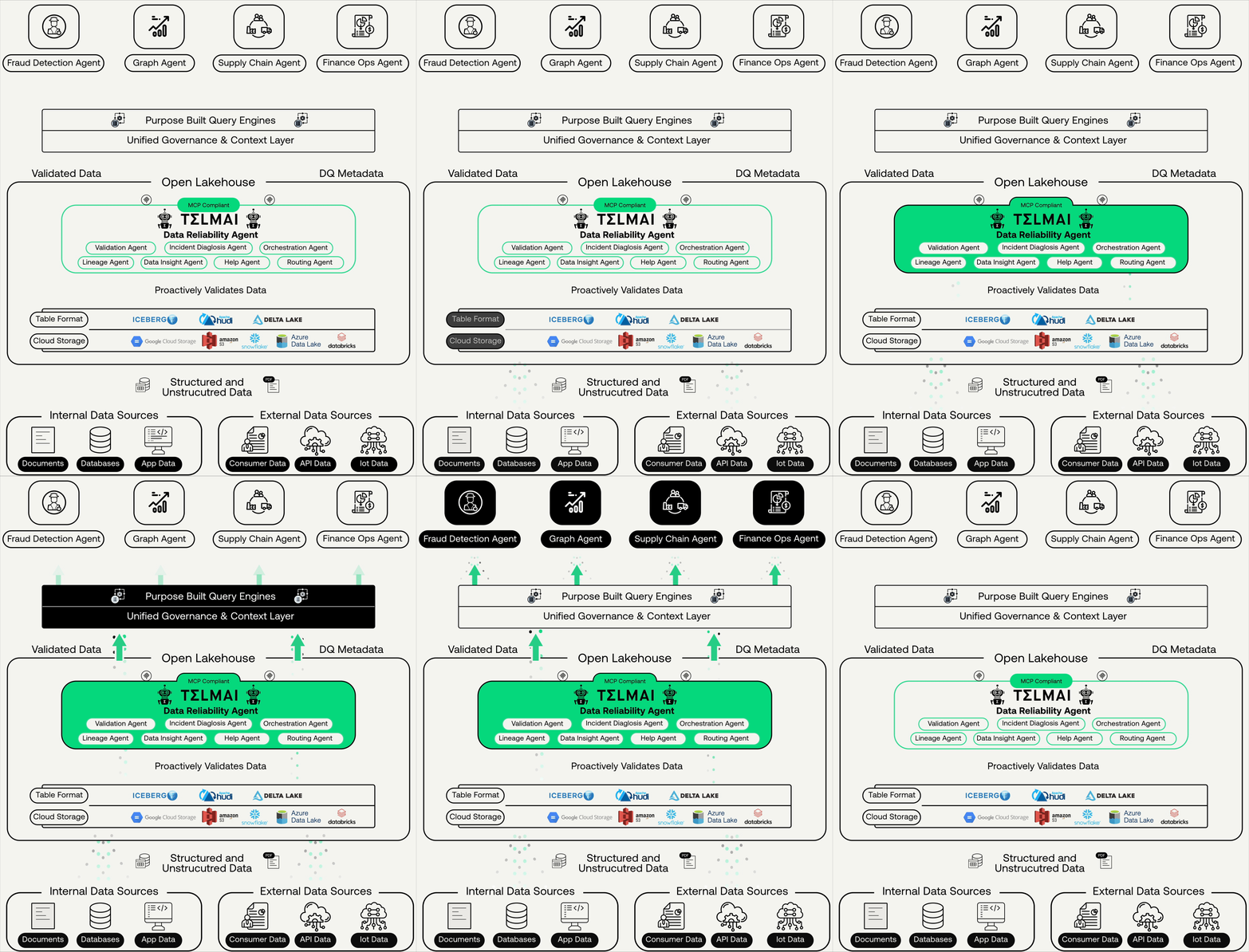
Telmai has the unique ability to continuously validate, monitor, and enrich data with quality signals at the lake and can push that data quality metadata for consumption by agents.  This creates the trusted foundation that autonomous AI products need to operate reliably and at scale.

With Telmai’s latest product launch, AI agents can continuously access reliable data and the critical data quality context needed to automate downstream workflows.

Real-Time, Continuous, Agentic AI-Ready Data

Real time Ai ready data 2 (1)
Telmai’s Data Reliability Agents ensures continuous validation, context, and governance across open lakehouses

At the core of this update is the introduction of Telmai’s MCP-compliant server, which enables LLM-powered agents like Claude, Bedrock, or Vertex to query Telmai directly. Telmai continuously validates data, whether structured, semi-structured, or unstructured. Additionally, it generates comprehensive data quality metadata alongside the validated data, providing essential context on data health to ensure the data is reliable and AI-ready. Through the MCP layer, AI agents can access and retrieve validated data and metadata into their agentic workflows, eliminating the need for third-party transformations or complex workarounds.

“In the era of model commoditization, true competitive advantage will emerge from trustworthy, dynamic, and contextually aware data,” said Sanjeev Mohan, industry analyst and principal at SanjMo. “Telmai’s latest release is a big step in this process. It offers continuous validation and contextual metadata that enable AI agents to act responsibly, while reducing the operational debt that has long hindered enterprise adoption.”

Natural Language AI Assistants & Decentralized Data Trust

Telmai Decentralizes Data Trust

Building on this foundation, Telmai is introducing a suite of AI assistants called Data Reliability Agents accessible through natural language interfaces, enabling both technical and non-technical users to interact directly with the platform. This decentralization means that ownership of data reliability no longer sits solely with engineering, accelerating time to value by making platform management and critical data quality insights accessible and actionable to all relevant stakeholders.

Autonomous Detection and Remediation

Telmai’s Data Reliability Agents enable autonomous detection and resolution of data anomalies. These intelligent agents continuously monitor data pipelines for irregularities and provide clear, plain-language explanations of root causes. Identifying and resolving complex data quality issues that once required deep technical expertise are now easily understood and addressed by both technical and business teams. Beyond detection, the Data Reliability Agents provide actionable recommendations and assist in generating data quality rules tailored to newly identified anomalies. 

Furthermore, these Data Reliability Agents augment existing automated workflows, such as ticket creation and alert triggers, to help data teams proactively adapt and drive continuous improvement in their data quality processes.

This comprehensive approach closes the loop from detection through triage and remediation, ensuring that data being fed into the downstream processes is not only trustworthy but consistently ready for autonomous consumption and decision-making.

“As AI agents take the reins of decision-making, we believe autonomy should never come at the cost of reliability,” said Mona Rakibe, Co-founder & CEO of Telmai. “With these updates, Telmai is laying the groundwork for true intelligent automation and allowing enterprise data teams to shift their focus to driving measurable business value via Agentic AI.”

For more information or to learn more about Telmai’s Data Reliability Agents, request early access today.

Want to stay ahead on best practices and product insights? Click here to subscribe to our newsletter for expert guidance on building reliable, AI-ready data pipelines.