Bringing Continuous Data Trust to Microsoft OneLake with Telmai
As enterprises scale agentic and autonomous AI systems, the need for reliable, explainable data at the lakehouse layer has never been higher. This blog walks through why data teams are shifting to open, federated architectures and how Telmai’s native integration with Microsoft OneLake ensures every dataset is continuously validated and AI-ready.

The rise of agentic and autonomous systems is reshaping enterprise data strategies. To support these intelligent and adaptive workloads, data teams are adopting open, federated lakehouse architectures that enable interoperability, data portability, and scalable AI execution across distributed environments.Microsoft Fabric’s OneLake serves as the backbone of this new paradigm, providing a unified, governable data lake that consolidates all data assets across various formats and environments. Yet, for agentic and autonomous applications to succeed, enterprises need low-latency, trusted, and explainable data, making continuous validation at the data lake layer essential.
As a recognized leader in AI-powered data observability, Telmai has partnered with Microsoft to embed native data reliability directly into OneLake, building on its existing integration with Azure Data Lake Storage (ADLS). Telmai is also now generally available on the Microsoft Azure Marketplace, enabling Azure customers to purchase and deploy Telmai within their data ecosystem seamlessly.
The Data Quality Imperative for Scalable Advanced Agentic AI Workloads
The failure point for most AI initiatives isn’t in the model itself, but rather in the underlying data pipelines that feed them. As AI and autonomous systems operate at machine speed, data pipelines are increasingly architected to ingest data from diverse, distributed sources in real-time. This demands that the underlying systems within a data estate prioritize interoperability and composability, a shift that has driven enterprise data teams to embrace open and federated lakehouse architectures.
However, this level of flexibility and interoperability introduces significant complexity in maintaining consistent data quality across distributed data domains. Data now flows across multiple cloud environments, powered by various query engines and managed by teams with different maturity levels. This fragmentation makes it increasingly challenging to maintain a unified, trustworthy view of data quality.
To successfully move AI initiatives from pilot to production, data teams must ensure that every dataset entering the lake is continuously validated, contextually enriched, and explainable. Without this foundational trust, model outputs and autonomous workflows risk becoming unpredictable or non-compliant, undermining the very intelligence they were built to deliver.
How Telmai Ensures Trusted, AI-Ready Data Pipelines in OneLake
Telmai’s native integration with Microsoft OneLake addresses these challenges by embedding continuous data validation and reliability directly into the data lake layer. Designed for open, federated architectures, it ensures that every dataset landing in OneLake is validated, explainable, and ready for consumption by both humans and AI systems.
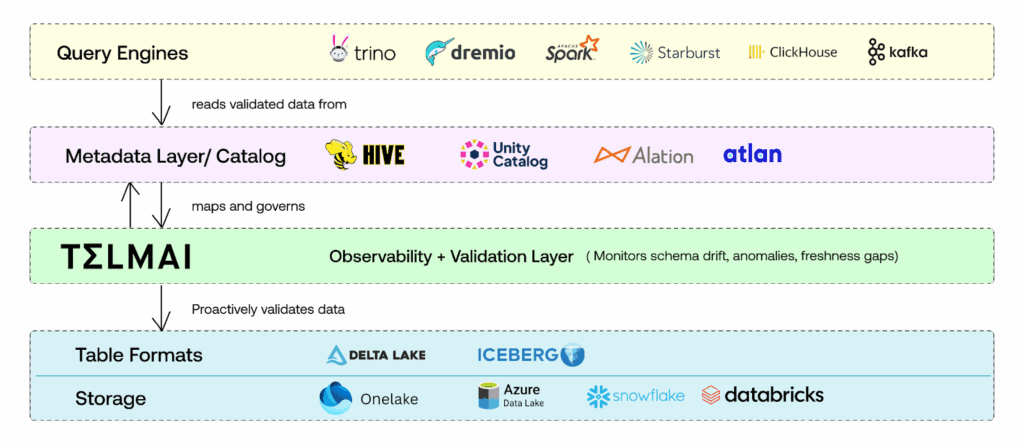
Telmai continuously validates every piece of data and attaches granular data-quality metadata as it flows into OneLake, whether structured, semi-structured, or unstructured data and supports for open table formats like Apache Iceberg and Delta Lake. This ensures that downstream systems have access to data that is accurate, contextualized, and trustworthy.
What truly differentiates Telmai is its AI-powered Data Reliability Agents. These agents allow both technical and business users to query incidents in natural language, understand root causes, and implement validation checks, as well as set up data monitors without requiring coding expertise. This capability not only democratizes access to trusted data but also reduces the time between detection and resolution, which is a crucial factor when working with real-time or autonomous workloads.
Additionally, Telmai’s MCP-compliant quality signals make data reliability directly consumable by AI agents and automation frameworks. These real-time signals enable autonomous decision-making systems to assess data trustworthiness before taking action, thereby enhancing safety and explainability in enterprise AI operations.
By combining continuous validation, human-in-the-loop explainability, and machine-readable trust signals, Telmai transforms OneLake into a foundation of reliability for agentic and autonomous ready data pipelines.
Closing Notes
Telmai’s native integration with Microsoft OneLake empowers organizations to build trusted, AI-ready data pipelines that meet the demands of modern agentic and autonomous applications.
By embedding observability directly within the OneLake environment, Telmai bridges the gap between data quality and AI readiness, helping enterprise data teams scale their AI implementations from pilot to production faster and with greater confidence.
Telmai is now available on the Microsoft Azure Marketplace, allowing Azure customers to easily deploy it within their ecosystem by applying their Microsoft Azure Consumption Commitment (MACC) toward the purchase.
To learn more about how Telmai can help you build trusted, AI-ready data pipelines in Microsoft OneLake, book a tailored demo with our team of experts today.
Want to stay ahead on best practices and product insights? Click here to subscribe to our newsletter for expert guidance on building reliable, AI-ready data pipelines.
- On this page
See what’s possible with Telmai
Request a demo to see the full power of Telmai’s data observability tool for yourself.