Bringing Context-Aware Data Observability To Unity Catalog
Enterprise data teams are leaning harder on autonomous workflows to drive business and strategic outcomes. Agentic applications ingest, transform, and act on data in real time. Yet the data powering them is rarely monitored continuously and carries no quality context at runtime. The challenge grows as data ecosystems become heterogeneous and distributed, with quality defined […]

Enterprise data teams are leaning harder on autonomous workflows to drive business and strategic outcomes. Agentic applications ingest, transform, and act on data in real time. Yet the data powering them is rarely monitored continuously and carries no quality context at runtime. The challenge grows as data ecosystems become heterogeneous and distributed, with quality defined differently across domain teams.
Telmai’s Unity Catalog integration, now generally available, closes this gap with context-aware observability on the Databricks platform. This article walks through why the gap exists, how the integration works, and what it means for teams building on Databricks.
The Cost Of Observability Without Context
Enterprise data platforms are consolidating around a simpler stack. An open lakehouse holds thousands of tables produced by domain pipelines. Those tables move through bronze, silver, and gold layers. Each layer conforms the data to business logic before it reaches BI reports and agentic applications.
A data catalog makes that data discoverable, recording what exists, who owns it, and how it is used. Data observability solutions monitor and validate the data to ensure it is reliable and fit for data-driven operations. Both are critical to enterprise data management, yet they have always operated as standalone systems. This worked well when a human analyst stitched the context together over days.
There is a critical gap, however, when agents are the primary consumers. Agents process and act on data in real time with no quality context. By the time an incident is identified, the downstream impact has landed, and trust in data-driven operations has taken a hit. Root cause analysis after the fact takes longer and costs more. Remediation pulls engineering time into triage instead of strategic outcomes.
Observability has to stop being a dashboard or an incident queue and become a signal an agent reads before it acts. That requires a single quality layer, with catalog and observability operating as one. The quality layer draws on the catalog to give observability its business context and identify the data assets that are critical to the business. Those assets are prioritized and proactively monitored from day one. The quality layer then writes trust signals back so every downstream agent and workflow inherits them. This is the approach behind Telmai’s Unity Catalog integration. The next section walks through how it works on Databricks.
How Telmai Works With Unity Catalog
Through its native integration, Telmai connects to Unity Catalog and reads your Databricks estate from that one connection. It pulls metadata, usage, ownership, and lineage for every table in the workspace. No configuration is required, and no data is moved.
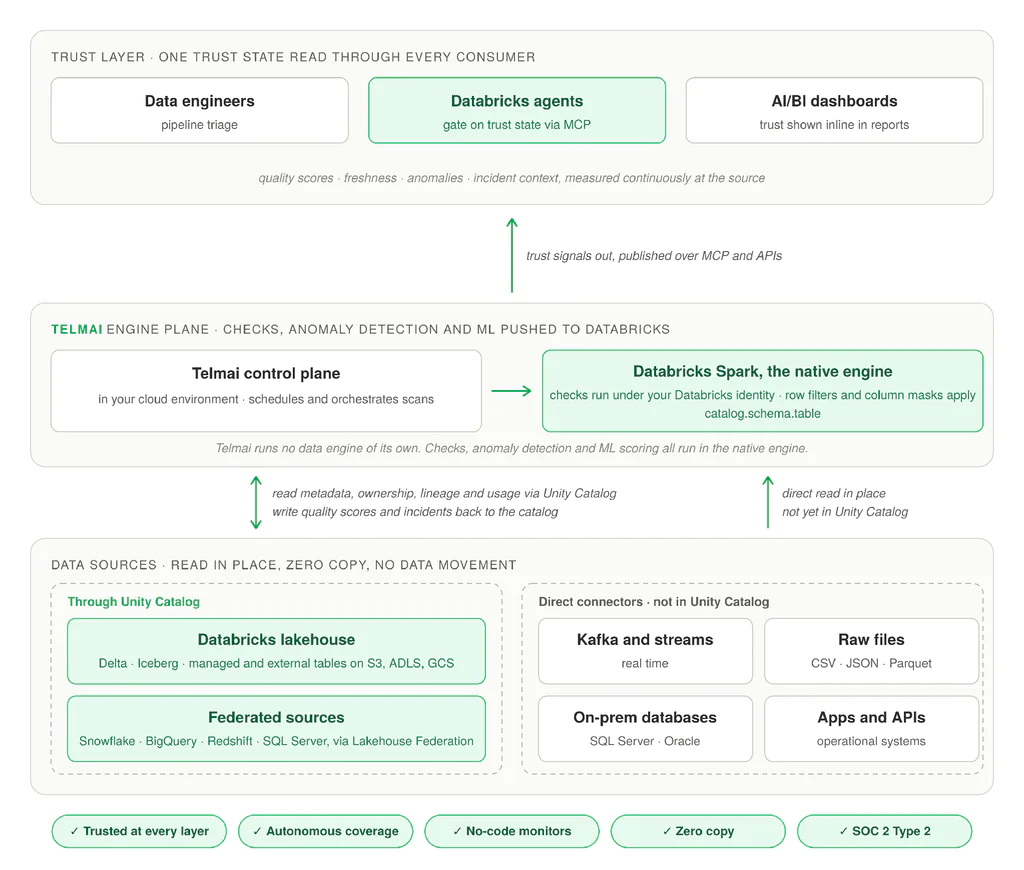
Telmai then scores each table on signals such as downstream impact, popularity, and ownership to surface critical data elements and the tables the business depends on. Priority is derived on day one and updates as new tables land in the catalog.
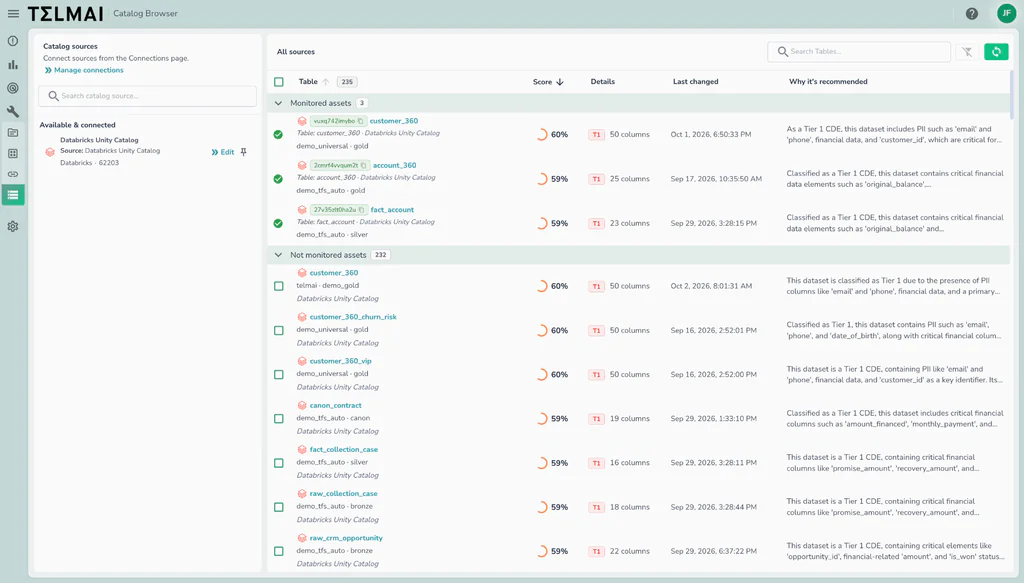
From that ranking and the business context in the catalog, Telmai recommends validation checks with thresholds tailored to each table’s baseline, and runs them across Delta Lake and Apache Iceberg tables in place. Results flow back into the catalog. Quality scores and incidents are written next to the asset, where teams already look for data. Telmai reads ownership and lineage again to route each incident to the stakeholders whose AI and BI products are affected, with root cause and recommended next steps attached.
Everything Telmai extracts is consumable at runtime. Quality state, incidents, ownership, and impact are exposed through Telmai’s MCP server and APIs, so an agent retrieves the context it needs in a single call before it acts. This is what turns observability from an incident queue into a signal, and what makes Unity Catalog a foundation of reliability for agentic and autonomous pipelines on Databricks.
Closing Notes
Telmai’s native integration with Databricks Unity Catalog gives data teams a single quality layer where catalog context and observability operate as one.
By reading context from Unity Catalog and returning quality signals to it, Telmai closes the gap between governance and validation, helping enterprise data teams ensure their data is ready for autonomous workloads.
To see how Telmai can help you build trusted, AI-ready data pipelines on Databricks, book a tailored demo with our team.
Want to stay ahead on best practices and product insights? Subscribe to our newsletter for expert guidance on building reliable, AI-ready data pipelines.
- On this page
See what’s possible with Telmai
Request a demo to see the full power of Telmai’s data observability tool for yourself.