How PropertyGuru Automated Data Quality Across Google Cloud Platform With Telmai
Discover how PropertyGuru Group scaled data quality with Telmai’s ML-powered observability on Google Cloud Platform, achieving an 80-90% reduction in escalations and 30-40% lower operational costs while enabling their data and engineering teams to focus on strategic business initiatives
Overview
PropertyGuru Group is a leading property technology company in Southeast Asia, powering property discovery, listings, and insights across multiple markets. With millions of property listings and customer interactions flowing through its platforms daily, PropertyGuru relies heavily on accurate, timely, and trustworthy data to deliver high-quality customer experiences and support data-driven business decisions.
At the core of its platform is a large-scale data ecosystem that ingests data from a wide range of internal systems and third-party sources, transforming it into analytics, valuation models, recommendation systems, and several other AI-powered data products, focused on value creation for PropertyGuru’s consumers and customers. These systems depend on consistent, reliable data to operate effectively at scale.
As a result, data quality at PropertyGuru was not just an analytics concern. It directly influenced product experiences, trust in PropertyGuru’s marketplaces and ML-driven use cases, and stakeholder confidence across teams.
Key Success Metrics:
- 30-40% reduction in data remediation and operational overhead
- 80-90% reduction in downstream data quality escalations
- Root cause analysis time reduced from hours to minutes with Telmai’s Investigator workflow
- Proactive data anomaly detection based on pre-configured rules based on various product KPIs, business cases, and scenarios
Challenge: Reactive Data Quality in a Fast-Moving Business
PropertyGuru’s Data Center of Excellence (COE) team operates a centralized data warehouse that serves as the organization’s source of truth for reporting and business intelligence.
As custodians of this critical system, the team manages data ingestion and transformation through well-established governance processes and security controls designed to ensure data integrity, protection, and responsible access across the organization. Within this governed environment, data is ingested from a wide range of upstream sources, including property listings, transaction records, finance systems, analytics platforms, and third-party data providers across multiple Southeast Asian markets.
This data is then transformed into aggregated datasets and derived data products that power downstream use cases across the organization, including management and business reporting, customer-facing applications, machine learning and valuation models, and data products consumed by internal teams.
While some upstream systems enforced strict controls, the team faced mounting challenges as data volumes and use cases expanded:
- Inconsistent upstream guardrails: Not all source systems enforced strong quality gates, leading to completeness issues, outliers, and schema inconsistencies downstream
- Reactive data quality processes: Data quality issues were often identified after downstream teams or business users flagged problems, leading to firefighting rather than prevention
- Operational overhead for data teams: Engineers spent significant time writing ad hoc queries and investigating issues, rather than focusing on strategic initiatives that drove business growth
- Limited visibility into data health across pipelines: While issues could be identified through manual analysis, there was no centralized, visual layer that provided continuous insight into data quality health across datasets
Although PropertyGuru had invested in internal data quality checks and alerting mechanisms, these approaches required significant maintenance and still relied heavily on manual querying and tribal knowledge to diagnose issues.
The team needed a way to proactively detect data issues, quickly identify their root causes, and reduce the operational overhead of maintaining homegrown tooling.
Evaluation: From Homegrown Tools to A Proactive, AI-Driven Approach
PropertyGuru approached the data quality challenge with a clear build-versus-buy framework. Over several years, the team had built and maintained an internal data quality system with custom checks and alerting mechanisms. However, these homegrown tools required ongoing engineering effort and remained largely reactive.
Each new data source or quality check required custom development work. The framework was designed to solve specific, known problems reactively, but it struggled to proactively detect unexpected anomalies or patterns. Most importantly, the ongoing maintenance burden meant that engineering time spent extending and troubleshooting internal tooling was time not spent building revenue-generating Data and AI products.
As data volumes and downstream dependencies increased, it became clear that sustaining a custom-built approach would continue to divert engineering time away from higher-impact strategic initiatives that drove business growth.
PropertyGuru initiated a formal vendor evaluation to identify a purpose-built data observability and quality solution that could:
- Proactively detect anomalies and data issues before they impact the business
- Scale across large datasets and multi-cloud environments
- Support both deterministic rule-based checks and ML-driven anomaly detection
- Integrate seamlessly with existing data pipelines and workflows
- Deliver measurable operational and business value
The team evaluated multiple data observability platforms against a defined set of technical and operational criteria. Following this assessment, Telmai was selected for its ability to meet PropertyGuru’s requirements for proactive anomaly detection, scalable data profiling, visual investigation workflows, and governance capabilities, which aligned with their evaluation criteria for real-time monitoring and operational efficiency.
Solution: Embedding Proactive Data Quality into Production Workflows
To move away from reactive data quality processes, PropertyGuru adopted Telmai to bring centralized visibility and consistency to data quality monitoring across its critical production datasets for analytics, valuation, and downstream applications
Telmai was integrated directly into PropertyGuru’s existing data pipelines on Google Cloud Platform, continuously profiling and validating datasets as new data arrived. This integration enabled early detection of completeness issues, outliers, and schema inconsistencies before they could propagate into downstream systems or affect ML-driven use cases such as property valuation models.
One of PropertyGuru’s most persistent data-quality challenges involved property transaction data from third-party providers. With approximately 25,000 new transaction records arriving monthly, data completeness and consistency varied significantly by source, and PropertyGuru had limited control over upstream data creation processes.
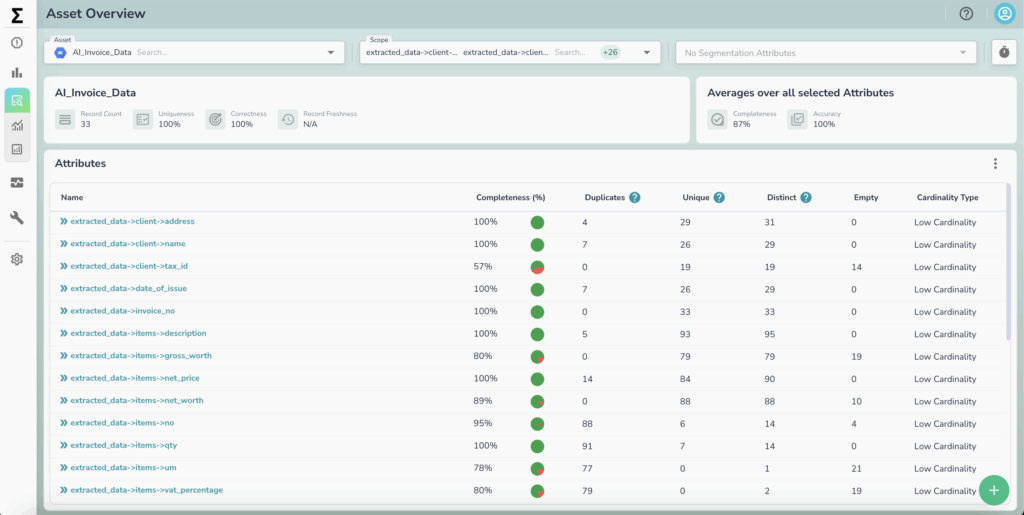
Telmai’s automated profiling and data validation checks enabled the team to immediately identify outliers, missing values, and schema inconsistencies as new batches arrived. In one example, Telmai flagged unexpected patterns in property valuation data that would have propagated into downstream analytics if left undetected. Catching these anomalies before they reached analytics dashboards or customer-facing applications prevented downstream confusion and maintained trust in PropertyGuru’s data products.
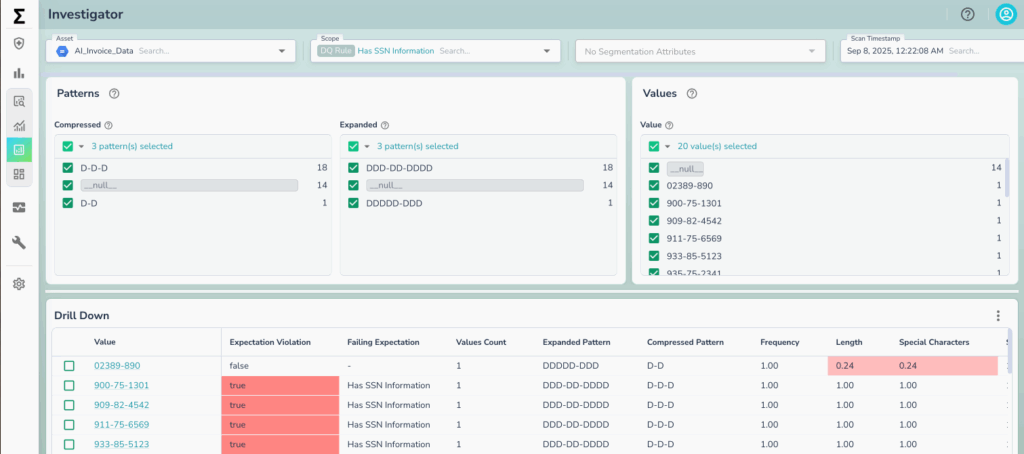
Perhaps the most immediate operational impact came from Telmai’s Investigator feature, which fundamentally changed how engineers diagnosed data quality issues. Rather than writing multiple ad hoc queries to understand the scope and severity of a problem, engineers could use Telmai’s visual interface to drill into problematic records, identify patterns, and pinpoint root causes in minutes rather than hours.
This shift reduced time spent on manual investigation and enabled data teams to focus on building and improving data and AI products rather than repeatedly diagnosing the same categories of quality issues.
Why Telmai
With Telmai in place, PropertyGuru began to see meaningful improvements across its data operations:
- A 30–40% reduction in data remediation and operational overhead
- A reduction in downstream escalations related to unexpected data behavior
- Faster identification of outliers and incomplete records in third-party data feeds
- Improved confidence in derived datasets powering valuation models and analytics
- Less time spent on manual investigation, allowing engineers to focus on higher-value initiatives
While PropertyGuru continues to expand its use of Telmai, the platform has already helped shift data quality from a reactive burden into a foundational capability for Data & AI products.
See what’s possible with Telmai
Request a demo to see the full power of Telmai’s data observability tool for yourself.